Spinal Fusion and Decompression Surgery
Spinal fusion and decompression are two of the most important operations in modern spine surgery.
They are often performed together and are the main treatment option for a range of conditions that cause chronic pain, neurological symptoms or spinal instability.
Contemporary minimally invasive techniques have transformed these procedures, offering equivalent outcomes with significantly less surgical trauma and faster recovery.
What is spinal fusion?
Spinal fusion is an operation in which two or more vertebrae are permanently joined together in order to stabilise the spine and relieve pain.
The fusion is achieved using bone graft, which may be taken from the patient or from a bone bank, and is usually combined with implants such as screws, rods and cages that provide immediate stability until the bone has healed.
Once fusion has matured, the implants are no longer essential, but in most cases they remain in place without causing problems.
What is spinal decompression?
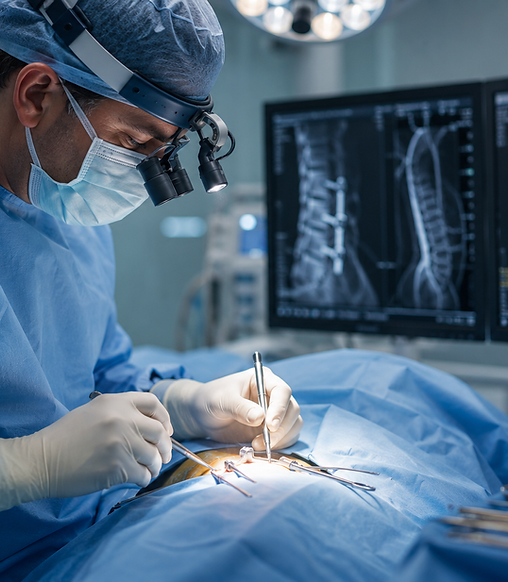
Spinal decompression is a surgical procedure in which bone or ligamentous structures that compress the nerve roots or spinal cord are removed. The aim is to create sufficient space for the nerves and to relieve neurological symptoms.
The most common decompression procedures are laminectomy, in which the posterior arch of the vertebra is removed, and foraminotomy, in which the exit canal of the nerve root is widened. In many cases, decompression is combined with fusion where there is associated spinal instability.
When do we perform spinal fusion?
Fusion is indicated in specific conditions and situations. The main indications include spondylolisthesis (dynamic slippage of one vertebra over the adjacent one), spinal instability after decompression, scoliosis and other deformities, unstable vertebral fractures, and spinal tumours requiring stabilisation after resection.
The decision to perform fusion is always individualised, based on imaging findings, clinical presentation and each patient’s needs.
Minimally invasive vs open surgery
Traditional open fusion requires large incisions and extensive detachment of the muscles from the spine, resulting in significant postoperative pain and prolonged recovery.
Minimally invasive techniques address this problem with a radically different approach. Instead of wide incisions and muscle stripping, tubular retractors are used to gradually dilate the soft tissues without cutting them.
The surgeon works through these tubes with the aid of a microscope, endoscope or fluoroscopy. The benefits include smaller incisions, reduced blood loss, lower risk of muscle damage and infection, faster recovery and decreased need for analgesia after surgery.
It is important to note that the minimally invasive approach is not suitable for all cases. In complex conditions or multilevel procedures, open surgery may be the safest and most effective option.
Surgical techniques

Percutaneous spinal fusion
Percutaneous fusion is the most characteristic minimally invasive stabilisation technique.
Implants are inserted through very small skin incisions without the need for a larger cut or detachment of the underlying muscles.
Using fluoroscopy or surgical navigation, guide wires are introduced percutaneously into the vertebrae and the screws follow the same track with high accuracy.
Robotic navigation has further enhanced the precision and safety of this technique.
.png)
TLIF – Transforaminal lumbar interbody fusion
TLIF is one of the most frequently used minimally invasive fusion techniques. It is performed posteriorly through small incisions.
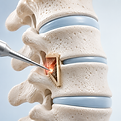
The degenerated disc is removed and a special cage filled with bone graft is placed into the disc space, restoring disc height and facilitating bony fusion. At the same time, the implants stabilise the affected levels.
TLIF is particularly indicated for spondylolisthesis, degenerative disc disease and recurrent disc herniation.

XLIF – Lateral lumbar interbody fusion
Lateral access is especially useful in the lumbar spine, as approaching from the side of the body allows placement of a larger cage with minimal disruption of the muscular tissues.
The patient is positioned in the lateral decubitus position and a tubular retractor is advanced to the lateral surface of the spine.
This technique offers excellent results in cases of degenerative disc disease and scoliosis.

Specialist expertise in spinal surgery
Spinal surgery is a major area of subspecialisation for Dr Mazarakis, who has a particular interest in minimally invasive techniques such as TLIF, XLIF, PLIF, navigation, robotic guidance and intraoperative neuro‑monitoring.
His experience in specialised centres in the United Kingdom and Ireland includes the management of complex cases requiring advanced decompression and stabilisation techniques.
Treatment is always tailored to the individual, with the aim of providing the safest and most effective solution for each patient.
Dr Mazarakis sees patients in Athens and Thessaloniki.
Recovery: time and rehabilitation
Recovery time after fusion depends on the extent of the procedure and the technique used. Following minimally invasive fusion, most patients mobilise the day after surgery and are discharged home within two to three days.
Return to office‑based work is usually achieved within two to four weeks, while physically demanding jobs may require three to six months.
Physiotherapy plays a central role in rehabilitation. Core‑strengthening, balance‑improvement and graded activity‑resumption programmes generally start within a few weeks of the operation.
Complete bony fusion is achieved over three to twelve months, depending on the extent of fusion and the patient’s general health.
Success rates and outcomes
Minimally invasive fusion shows high success rates in well‑selected patients. Significant improvement in pain and function is seen in the vast majority, and fusion rates are high with current techniques.
It is crucial to emphasise that outcome depends heavily on appropriate selection of both patient and technique. Fusion is not suitable for all cases of low back pain, and personalised assessment is key to achieving the best result.
Possible side effects and complications
As with any operation, spinal fusion carries certain risks. The most important include wound infection, bleeding, injury to neural structures, anaesthetic complications and pseudo‑arthrosis (failure of fusion), which may require revision surgery.
In the longer term, fusion can increase loading on adjacent levels, potentially leading to degenerative changes in those segments over time.
Minimally invasive techniques significantly reduce the risk of muscle damage, bleeding and infection compared with open surgery.