Endoscopic Spine Surgery
Endoscopic spine surgery represents the most advanced form of minimally invasive spinal surgery and has transformed the way we treat spinal disorders.
Through an incision of less than one centimetre, the surgeon gains direct access to the affected area without damaging the muscles, ligaments or bone.
The result is significantly reduced postoperative pain, faster recovery and a return to everyday activities in record time.
What is endoscopic spine surgery?
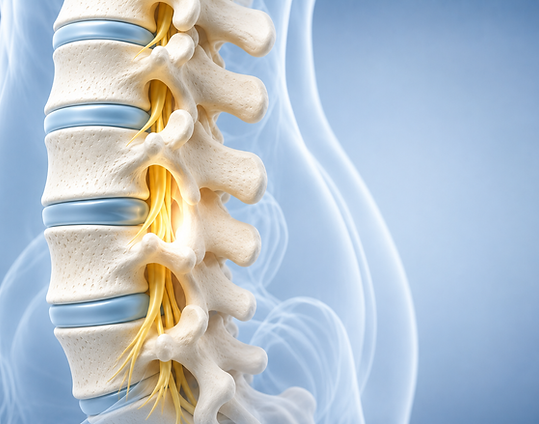
You can think of the spine as a chain of bones that protects the spinal cord and the nerve roots. Endoscopic spine surgery is performed through a very small incision, usually less than one centimetre.
The surgeon introduces a slender tube to reach the area of interest and then passes a specialised endoscope through it, which displays the operative field clearly on a high‑definition screen.
The endoscope has a dedicated working channel for surgical instruments, so a second incision is not needed.
In this way, the surgeon can reach the exact pathological site in the spine with minimal disruption to muscles, ligaments and surrounding tissues.
How does it compare with traditional open surgery?
Traditional open spine surgery requires a larger incision, meaning the surgeon must separate and often injure the paraspinal muscles – the muscles that allow flexion, side‑bending and rotation of the trunk. In many cases, removal of bone is also necessary to access deeper structures.
By contrast, the endoscopic technique uses specialised instruments and a micro‑incision, allowing the surgeon to operate with precision without damaging the surrounding tissues. This dramatically reduces postoperative pain, blood loss, complication risk and recovery time.
How is the procedure performed?
Endoscopic spine surgery is carried out in four phases.
Διαδικασία
Diagnosis and preparation
Detailed imaging with MRI is performed to pinpoint the lesion accurately. The patient is positioned prone under general or local anaesthesia.
Access
A micro‑incision of less than one centimetre is made, guided by real‑time fluoroscopy (X‑ray).
Endoscopic surgery
The endoscope is inserted through the working channel and the surgeon removes the disc material, osteophyte or hypertrophic ligament compressing the neural structures.
Closure
Haemostasis is achieved and the incision is closed with a single stitch.
Total operating time ranges from 45 to 120 minutes, with average blood loss below 50 ml.

Which conditions is it suitable for?
Endoscopic spine surgery is used in a wide range of conditions, including:
-
Lumbar disc herniation
-
Spinal canal stenosis
-
Cervical foraminotomy for nerve root decompression
-
Revision surgery, where avoiding scar tissue from previous operations is crucial
Advantages of the endoscopic approach
Preserving the integrity of the muscle–ligament complex substantially reduces postoperative inflammation and pain.
Mobilisation can begin within hours after surgery and physiotherapy usually starts on the first postoperative day.
Other important advantages include smaller incisions with a better cosmetic result, reduced infection risk, minimal blood loss and a decreased need for analgesia after the procedure.
Outcomes and success rates
The long‑term results of endoscopic spine surgery are excellent. According to a meta‑analysis published in World Neurosurgery in 2024, 85–95 per cent of patients report satisfaction with their outcome five years after surgery.
Recurrence prevention is achieved through targeted core strengthening and weight management. Patients are reassessed one to three months postoperatively with MRI.
When is endoscopy not the right choice?
It is important to emphasise that endoscopic spine surgery is not always the most appropriate option. Technique selection depends on correct indication, patient anatomy, extent of disease and the surgeon’s experience.
In complex conditions requiring extensive decompression or discectomy, traditional open or other minimally invasive surgery may be the safest and most effective choice.
Open discussion between surgeon and patient about the most suitable, individualised treatment approach is an integral part of care.
Dr Nektarios Mazarakis
Patient‑centred surgery
In spine surgery, technique should not be chosen simply because it is fashionable or popular at a given time.
Endoscopy is a powerful tool – but it is not the single answer for every case.
Dr Mazarakis, trained in leading centres in the United Kingdom and Ireland and experienced in a wide range of minimally invasive techniques, assesses each case in its entirety and selects the approach that best serves the individual patient.
He sees patients in both Athens and Thessaloniki.
